Productivity Software
Plan Japanese study around travel situations
Start with your needs
Start with a travel-moment list rather than a vague goal. Write six situations you expect to face, such as arriving, ordering food, asking directions, shopping, checking in, or making a polite greeting. For each, note one outcome you want: understand a question, give a short answer, or recognize written information.
Rocket Japanese says its course includes practice for both sides of common Japanese conversations, downloadable audio tracks, lessons for reading and writing, and cultural topics such as greetings, foods, holidays, and local customs. Treat these as distinct study modes when comparing a course with your own travel list.
Build your comparison
Build a small weekly rotation: one conversation scenario, one listening session, one reading or writing task, and one cultural note. Keep the same scenario across the activities. For example, listen for a restaurant exchange, say your part aloud, recognize a menu-related item, then note an appropriate greeting or courtesy phrase to investigate.
The provider describes lessons tailored around Japanese-Language Proficiency Test (JLPT) levels of competency and says it teaches the language step by step. That can be useful context, but a traveler can still judge fit by whether the early material matches the situations they wrote down.
Use a simple evidence log after each session: “understood without text,” “said aloud,” “read or wrote,” and “needs another pass.” Record one phrase or pattern—not a large word list. At week’s end, replay or restate the same scenario without looking at notes, then choose the next scenario based on the weakest column.
Before committing to a routine, inspect a sample lesson or course description for the formats you will actually use while traveling: audio for listening, spoken practice for replies, and text support for signs or messages. Select a manageable first scenario and repeat it until your responses feel less rehearsed.
Visual steps
Use these original planning illustrations alongside the measurements and questions in your own brief.
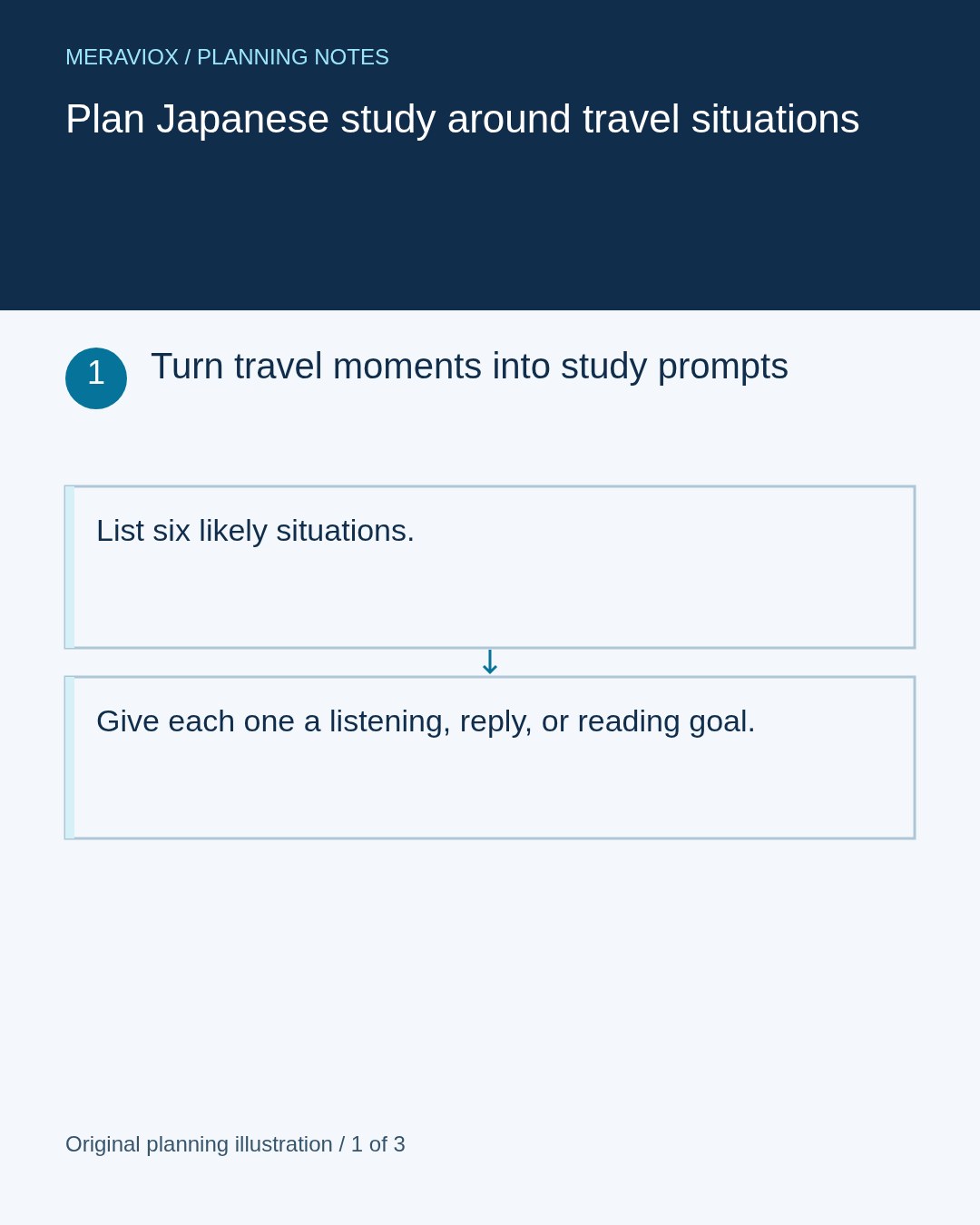
Step 1. Turn travel moments into study prompts. List six likely situations. Give each one a listening, reply, or reading goal. Original Meraviox planning diagram, rendered to sRGB JPEG; not a product photograph. 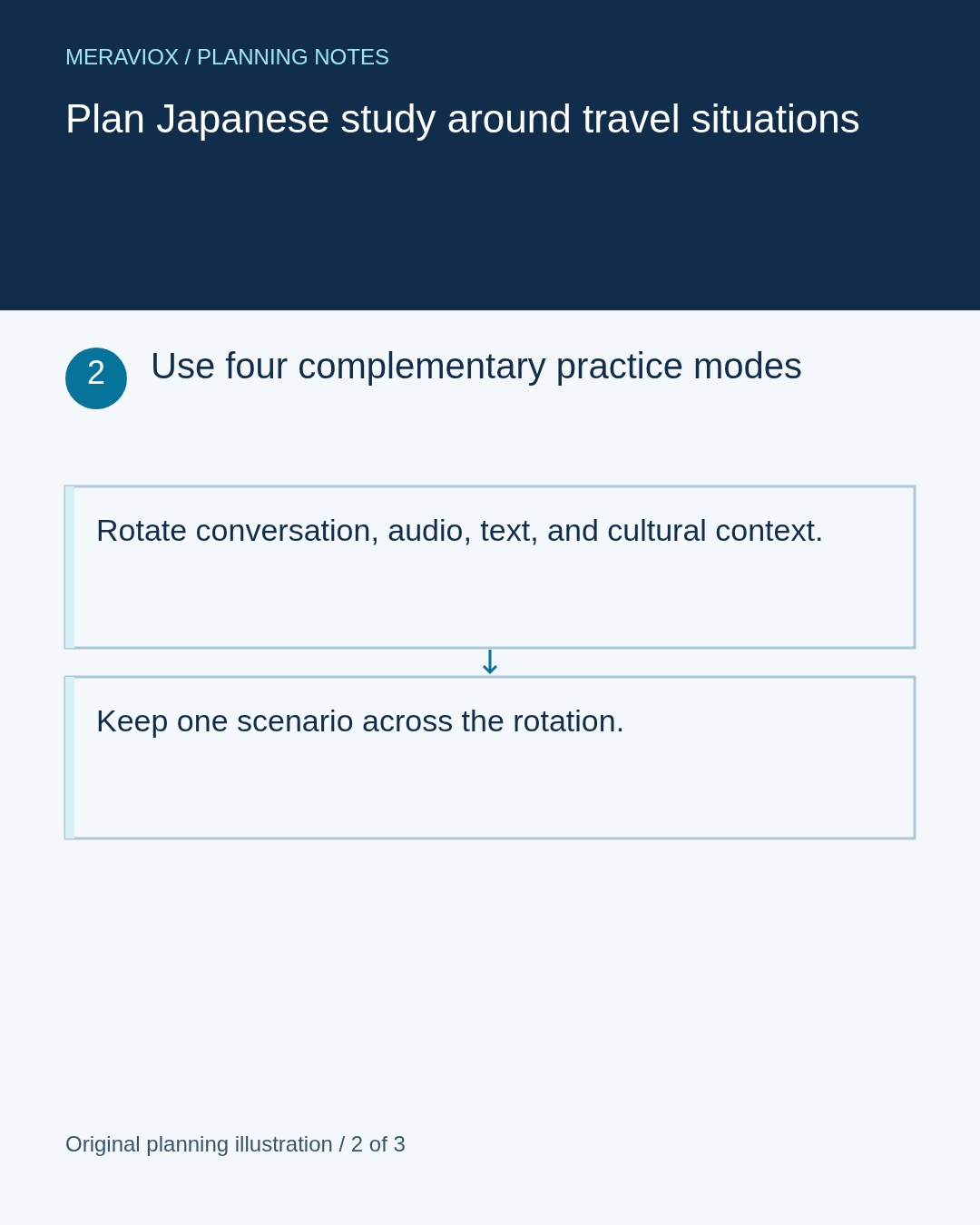
Step 2. Use four complementary practice modes. Rotate conversation, audio, text, and cultural context. Keep one scenario across the rotation. Original Meraviox planning diagram, rendered to sRGB JPEG; not a product photograph. 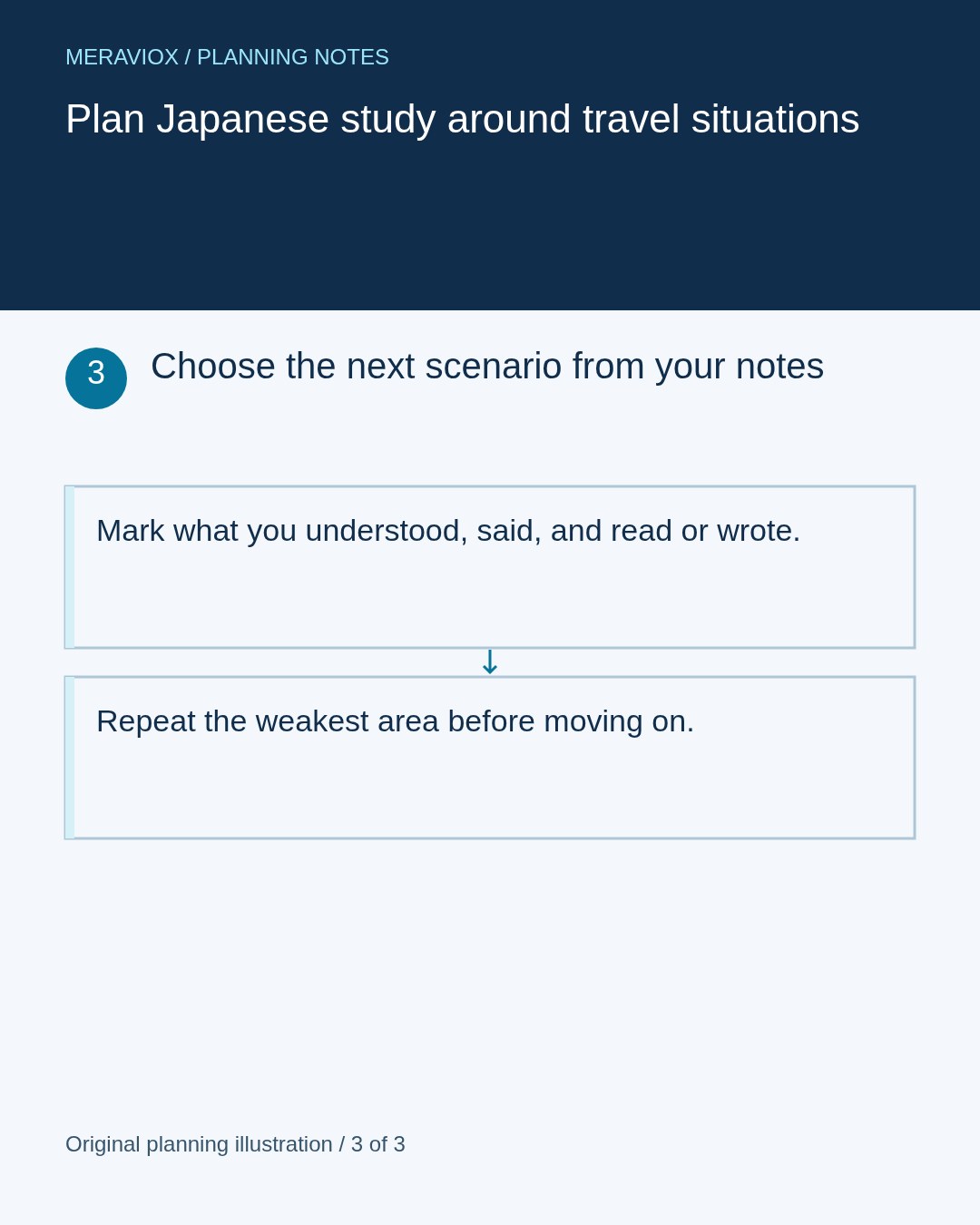
Step 3. Choose the next scenario from your notes. Mark what you understood, said, and read or wrote. Repeat the weakest area before moving on. Original Meraviox planning diagram, rendered to sRGB JPEG; not a product photograph.
Your planning brief
Keep the following fields together in your notes. Leave unresolved values labelled as unknown.
- List six likely situations.
- Give each one a listening, reply, or reading goal.
- Rotate conversation, audio, text, and cultural context.
- Keep one scenario across the rotation.
- Mark what you understood, said, and read or wrote.
- Repeat the weakest area before moving on.
Sources and scope
- source-1: Public page only; no tested experience, provider entitlement or financial outcome verified.
- source-2: Public page only; no tested experience, provider entitlement or financial outcome verified.
- source-3: Public page only; no tested experience, provider entitlement or financial outcome verified.